





For the best part of this century, many have sensed that the wasteful ways of modern industrialised civilisation have been rapidly catching up with us. Those of us who recognise the extreme urgency of our predicament and who view the health of both the environment and society as a single, interconnected issue, have our work cut out for us.
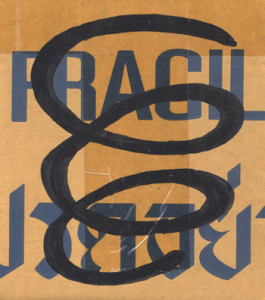
Fragile Spring: found cardboard box, India ink, 6" x 6". Alyce Santoro 2008
Revealing the value of the intangible has long been the domain of shamans, homeopaths, permaculturists and conceptual artists – and is perhaps one of the best hopes we have for rapidly shifting our culture towards one of increased efficiency and sustainability. Many contemporary artists are finding themselves inadvertently part of a new of movement that includes a sense of responsibility for defending the environment. Frustrated by a system based on mindless overconsumption of limited resources, they are choosing to develop creative, alternative ways to live, work, and communicate. Organisations such as Ecoartspace, The Center for Sustainable Practice in the Arts , the Sheila T. Johnson Design Center at Parsons/The New School for Social Research and Art & Science Collaborations, Inc are assisting in the emergence of this new interdisciplinary field.
Personally, I did not set out to become an activist. Initially, as an undergraduate marine biology student, I felt compelled to make art about the awe-inspiring phenomena of nature. As evidence of man-made threats to our ecosystems become increasingly apparent, artwork that documents, emphasises and reaffirms our relationship with nature has taken on profound new meaning. Like Beuys, Steiner, Goethe and others, I believe that until we recognise that our personal health, security, creativity and potential to thrive is not only not separate from the health of our environment, it is in fact derived from it, transformation of society will not be possible.
We have run out of time to simply make art about saving the planet – it is now our responsibility to make saving the planet our art. This requires conceptual continuity on all levels – materials selected, audience engagement, modes of transport for ourselves and our work and the daily environmental responsibility we take.
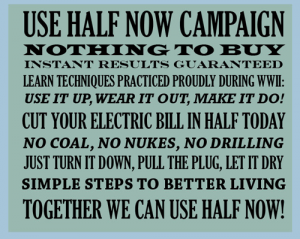
Use Half Now: promotional piece for a resources conservation campaign/idea-sharing community on Facebook hosted by Alyce Santoro, 2010
Anyone with an Internet connection can access a vast community where drawing on and contributing to the pool of sustainabile living knowledge and techniques makes these choices possible. My own experiments into homesteading (solar power, rainwater harvesting, gardening, etc.) have become a vital part of my creative practice, as has the USE HALF NOW a resources conservation community I host on Facebook.
Recently I was faced with the difficult task of deciding whether travel the 3000 mile round trip from west Texas to San Francisco to perform in the Soundwave “Green Sound” Festival . I researched the impact of driving versus flying using a carbon footprint calculator – and discovered that flying is much harder on the atmosphere. Ultimately, I concluded that a trip expending two-thirds of my entire average yearly consumption of gasoline to make a two-hour appearance at a festival devoted to environmental awareness could not be justified. We struck up a compromise – instead of a live performance, I would contribute an essay outlining the logic behind my absence and recorded materials of my practice .
As I looked into alternative ways to contribute, I discovered other festivals including Electrosmog, entirely dedicated to the development of low-impact ways to present and share visual and sound art.
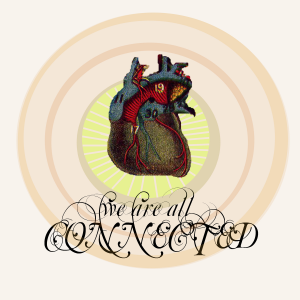
We Are All Connected: collage and digital media, Alyce Santoro 2010
In a culture that has, for so long, taken so many environmentally costly conveniences for granted, it can be a shock to discover the many ways in which our processes are entangled with them. We cannot, however, afford to continue operating under the premise that our personal actions do not make a difference. By living and working by example, artists, curators and wider society all have the power to shape our cultural perception of our place in nature and, more importantly, our responsibility towards it.
Joseph Beuys believed that infusing personal creativity into every action and treating even the most mundane facets of our lives as art forms leads to a healthy and meaningful existence and prepares us to make positive contributions to society. When we are all engaged, active participants, then, as Beuys proposed, Everyone is an Artist. In modern society, if living one’s life as art involves living as sustainably as possible, one is, by accident or design, a revolutionary. Believing that the dominant paradigm is corrupt and making a conscious decision to minimise participation in it is a radical act. In this sense, Everyone is an Activist as well.
Alyce Santoro
Watch More
http://www.youtube.com/watch?v=la8GSebZuog
http://www.youtube.com/watch?v=K-FGOL-s3p8
 This work is licensed under a Creative Commons Attribution-NonCommercial-ShareAlike 3.0 Australia.
[...] via Filter Magazine – filter.anat.org.au. [...]